About Us
Lois Bullion is a trade name of Britannia Jewellery Limited. Britannia Jewellery Limited is registered in England with company registration number 10948336. Britannia Jewellery Limited is a VAT registered company with VAT number 279 3821 62. Our registered office is 59-61 Charlotte Street St Pauls Square Birmingham, West Midlands, England, B3 1PX. We also operate in 41-42 Frederick Street, Hockley, Birmingham, B1 3HN. You can contact us by phone 0121 212 1715 or by email sales@lois-bullion.com
Purchasing
When purchasing bullion from Lois Bullion the prices are based on the financial markets, this price is always fluctuating and is out of our control. Due to fluctuations in price, once an order has been accepted, we are unable to accept cancellations or returns. You do not have any statutory rights to cancel or return an order under Regulation 13 of the Consumer Protection (Distance Selling) Regulations, Financial Services (Distance Marketing) Regulations or any other regulations. All orders are subject to being accepted by us. We reserve the right to cancel an order even if payment has already been made if a product has been mis-priced, you will be notified of this before the order is dispatched. When an order is placed you will receive an email notifying you that we have received your order, this does not mean the order has been accepted. Once your order has been accepted by us you will be notified by email. When your order has been dispatched you will receive a further email containing your tracking information.
Quality
Coins described as bullion may have marks, wear, discolouration or “milk spots” this will not affect the value as bullion. Some products may vary from the images displayed, with coins displaying different years or monarchs. Where best value items are chosen the item may be different from the one displayed on the image however, the bullion value will be the same. Where “best value” bars are purchased, the bars may not be in their original packing but this will not affect the value as bullion.
Investment advice
We are not authorized by the Financial Conduct Authority and cannot give investment advice. Historical metal prices are not a reliable indication of current or future metal prices. We cannot give advice regarding your tax implications.
Anti-Fraud and money laundering prevention
If you wish to purchase from us, you must register an account. We do not accept guest checkout. We are only able to post goods to the billing address. To make purchases with us over the value of £3000 in any 1-year period we will require an upload of photographic identification (Passport or UK Driving license) this is for anti-money laundering and anti-fraud purposes. To make purchases with us over the value of £10,000 we will require an upload of proof of address (utility bill, bank statement or driving license if not used as photo ID). Additional identification or verification may be required prior to dispatch for certain orders to comply with anti-money laundering and security requirements. We may use the information provided to perform anti-fraud checks. All information provided will be stored in accordance with the Data Protection Act. If you wish to make a purchase over £30,000 this must be done in store. We may ask for proof of identity or proof of address at any time.
Delivery
We rely on third-party companies to handle deliveries. We will always endeavour to ensure your items are dispatched and delivered to you without delay. Orders will be dispatched within 24 hours of the order being accepted if this is not possible, we will notify you at our earliest convenience. All orders over £150 will be delivered via Royal Mail Special Delivery, orders under £150 will be dispatched via Royal Mail 24H Tracked this requires a signature by the customer. Royal Mail Special Delivery aims for goods to be delivered within 24 hours of dispatch. If the buyer fails to take delivery of an item, we will not be held liable for any delays in delivery. Orders placed on Friday – Sunday will be dispatched on Monday excluding Bank Holidays. Larger orders may be dispatched in multiple packages.
We deliver to the United Kingdom only. We are only able to post goods to the billing address. Unfortunately, we do not deliver to the Channel Islands, a PO BOX address, a hotel address or unit addresses. We reserve the right to refuse to deliver to an address which may be deemed as being unsafe, unlawful, or unreasonable to do so. We are unable to accept responsibility for items delivered to houses of multiple occupancies. If a parcel arrives damaged or tampered with, you must not accept it and have the parcel returned to us. If an expected item has not been received you must notify us within 14 working days. Once parcels have been signed for the goods are now considered your own.
Collection
Orders placed online can be collected in store. You will be required to show a photographic ID matching the details on the order for in store collections.
Selling
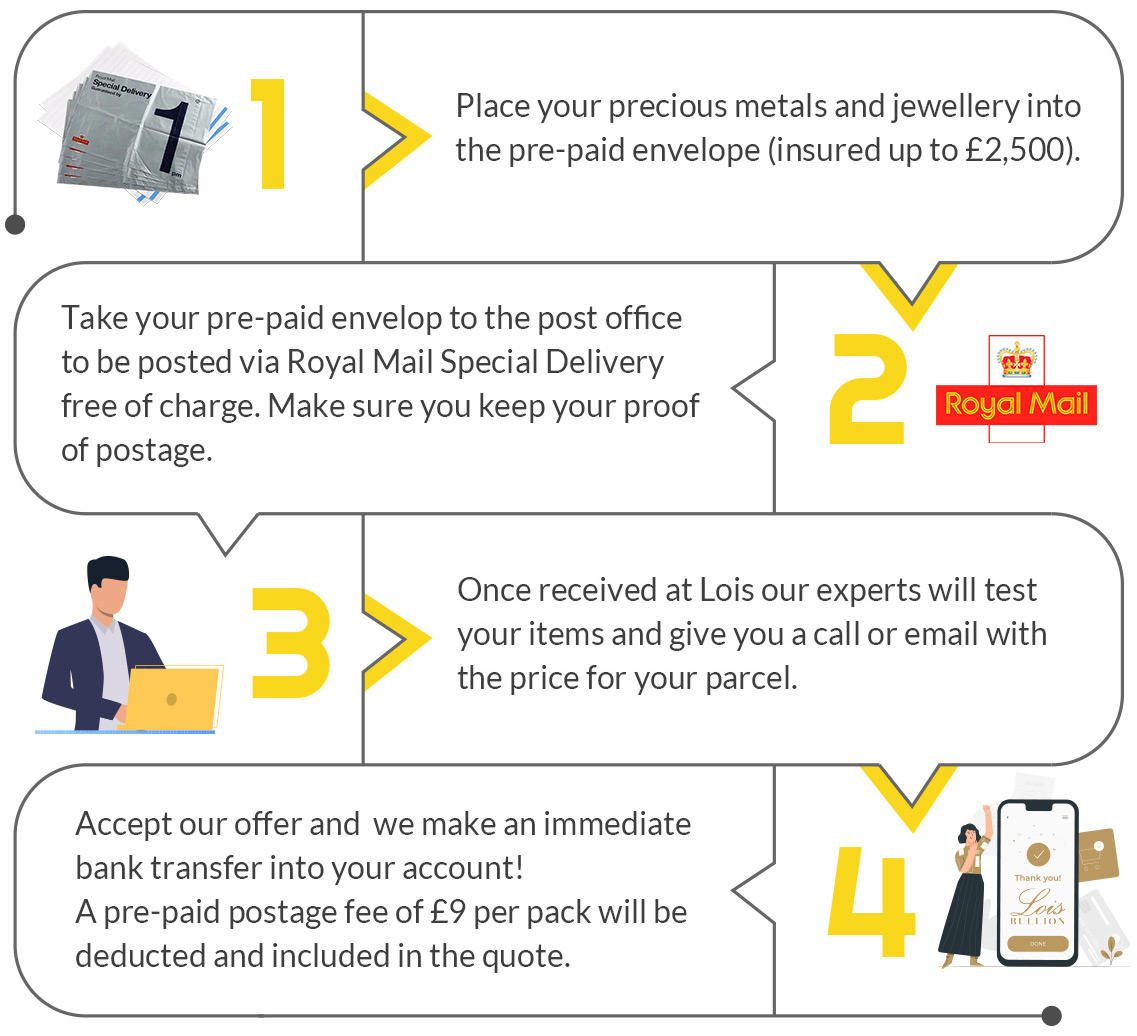
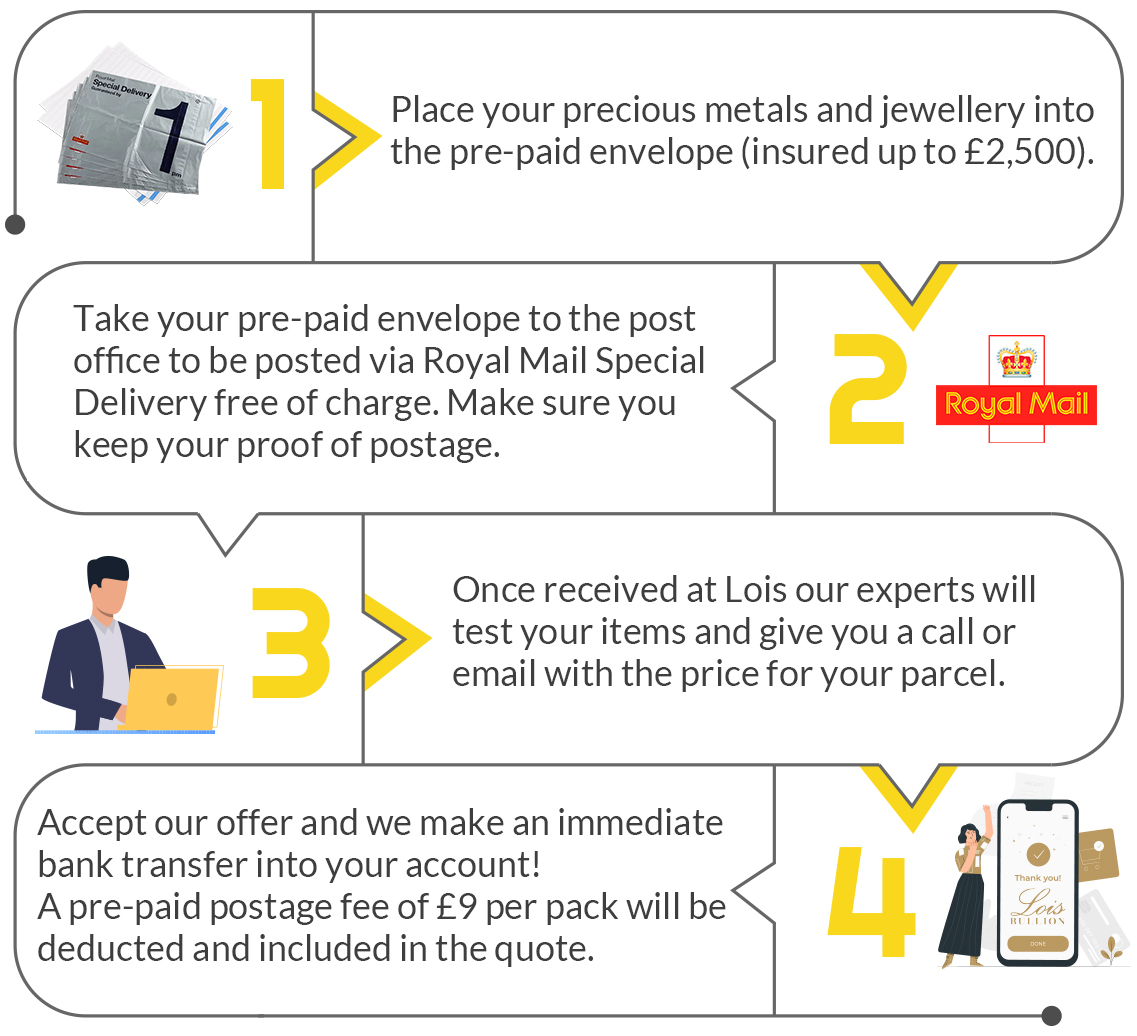
Customers must be over the age of 18 to sell goods to us. All goods sent to us must be police safe, and under your ownership. You must not knowingly send counterfeit or stolen goods to us. Prices displayed online or given through the Scrap Calculator are a guide price only. When we receive the goods, all items may be subjected to destructive and non-destructive testing. Items sent with stones of little or no value will have weight deducted in line with the weight of the stones. We reserve the right to remove stones without notifying you if we require an accurate weight, the stones cannot be returned in this case. Once testing has been completed to ascertain the weight and purity of the items, we will call or email you with an offer. The offer given will be based on the relevant metal price for that day for scrap items. Quotes for items will be updated with changes in the metal price and older quotes will no longer be valid. Items of jewellery will be priced separately depending on the item’s own merits. We are under no obligation to purchase the goods from you and reserve the right to post them back to you. Items being returned will be insured at our perceived value unless otherwise instructed if you require higher insurance this can be done at your cost. Return postage terms are as the delivery terms above.
Items of no value to us will be sent back to you upon your request only, and at a cost of £6.95 (this can be deducted from the value of other items). Items of no value that are not requested to be returned will be placed into a charity auction with proceeds going to Birmingham Children’s Hospital Charity. Items received on a Saturday will not be processed until the following Monday (bank holidays excluded).
For customers ordering one of our pre-paid packs a fee of £9 is deducted from the final value of your items. Each pre-paid pack includes Royal Mail’s £2,500 insurance limit per seller pack, which applies to loss in transit only and does not cover damage. If using the pre-paid pack service the customer is responsible for getting proof of postage and retaining the tracking. For goods with a value of less than £9 there will be a £9 fee for having the good returned to you. For goods being sent in the post, we recommend using Royal Mail Special Delivery and adding the correct insurance. Goods are the customers’ responsibility until we have taken delivery. Goods sent in via the post without information or a return address will be held for one week before being donated to charity. Customers using our postal service will have offers sent via email unless otherwise requested, please ensure only a secure email is used as once offers are accepted through the email link this is final. Once postal offers are accepted no further information can be provided as the items are moved to the next process. For selling in store, we will require at least one piece of photo ID to carry out the transaction other identification may be required. All sales of your goods are final and once goods have been paid for they are then classed as our property and cannot be requested back.
We only accept precious metals sent from addresses within the UK. We do not accept precious metals that has been posted from outside the UK.
We do not dispatch our free seller packs to addresses in the Channel Islands (Jersey and Guernsey). Customers from the Channel Islands who wish to send items to us must arrange this independently. If you choose not to accept our offer, it will be your responsibility to arrange and cover the cost of returning your items.
Payment
Payment can be made by bank transfer (to a UK bank), or by cheque, we do not post out cash. We endeavour to make payment on the same day the goods are received however, this is not always possible, and payments can take up to 3 working days. When providing bank details customers must make sure the details are correct as once payment is made it is not reversible. We take no liability for customers giving incorrect information. For instore transactions a cash payment is possible up to a sum of £3500. When being paid in cash it is the customers responsibility to check all monies before leaving the store as once you have left, we cannot accept responsibility for miss payment. We cannot make payments outside of the UK or to third parties.